North Korea has increasingly relied on a national security strategy based on asymmetric capabilities and weapons of mass destruction. To compensate for its conventional weaknesses, the regime has invested heavily in the development of increasingly long-range ballistic missiles and in reducing the size and weight of its nuclear warheads to enable their deployment on a broad range of weapons. These capabilities are designed to hold military forces and population centers at risk to deter external threats to the Kim family regime.
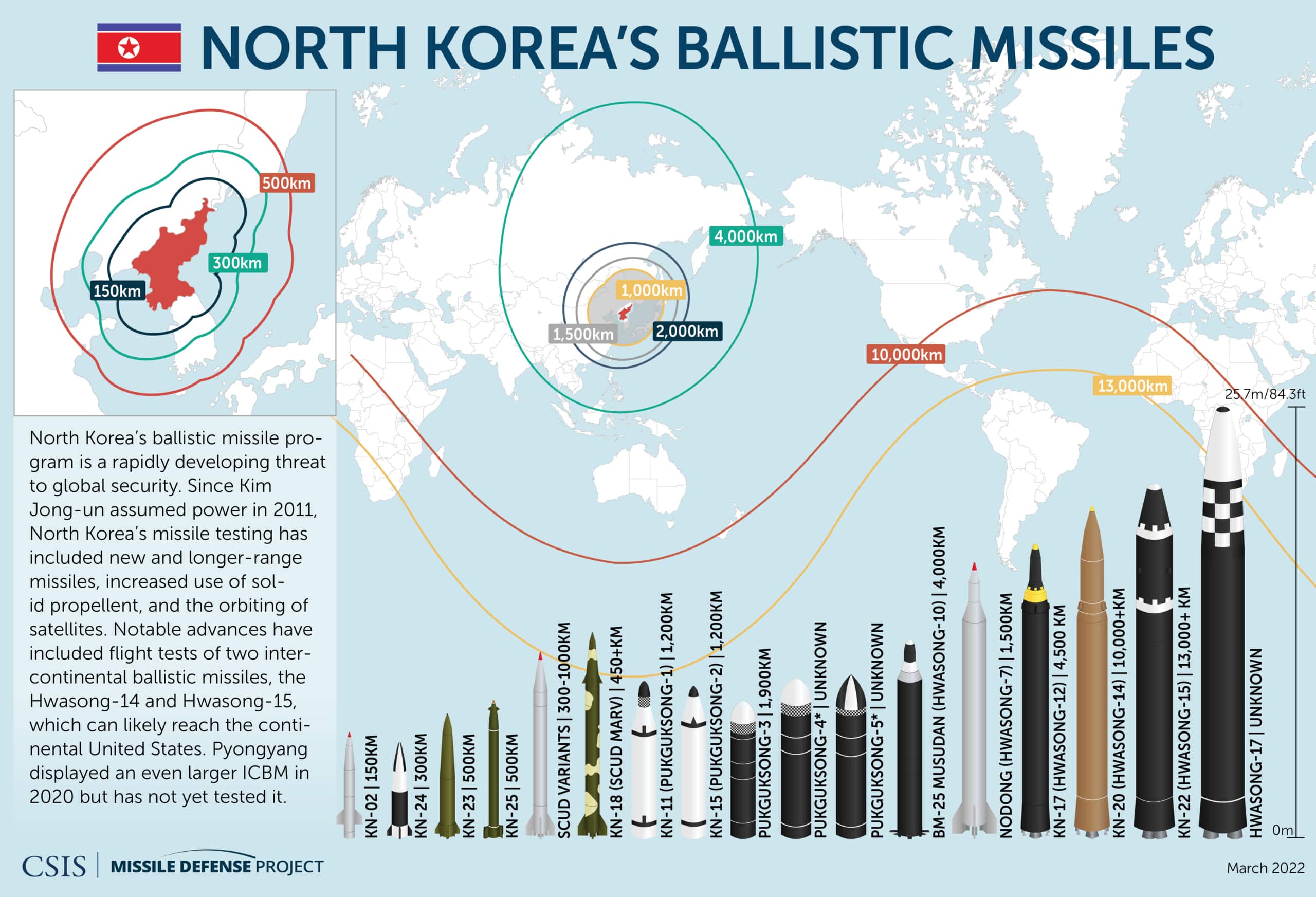
North Korea’s short- and medium-range systems include a host of artillery and short-range rockets, including its legacy Scud-based and No-Dong missiles. In 2019, North Korea tested a variety of new short-range, solid-fueled missiles such as the KN-23 and KN-25. North Korea has exported these weapon systems to Russia, which has employed them extensively in its war against Ukraine to strike both civilian and military targets.
Pyongyang has also advanced rapidly in long-range missile technology. It conducted its first intercontinental ballistic missile (ICBM) test for the Hwasong-14 in July 2017. This was followed by a test of a heavier ICBM design, the Hwasong-15, in November 2017. Much of this progress drew on technologies developed under Unha (Taepo-Dong 2) space launch program, which has been used to put crude satellites into orbit.
Recently, the North Korean military tested the large, liquid-fueled Hwasong-17 in 2022, the solid-fueled Hwasong-18 in 2023, and the emerging Hwasong-19 in 2024. In 2024, it also tested the Hwasong-16B, a solid-fueled, intermediate-range ballistic missile (IRBM) capable of carrying a hypersonic glide vehicle. Collectively, these systems demonstrate a shift toward the prioritization of greater range, mobility, survivability, and launch secrecy in its missile force. The regime is also pursuing operational concepts that would enable saturation attacks, including salvo launches, compressed timeline launches, and multi-azimuth attacks.
The development of North Korea’s intercontinental ballistic missile program was one of the primary motives behind the decision to field the U.S. Ground-based Midcourse Defense System to protect the homeland.
Missiles
| Missile Name | Class | Range | Status |
|---|---|---|---|
| BM-25 Musudan | IRBM | 2,500 - 4,000 km | In Development |
| Hwasong-12 | IRBM | 4,500 km | In Development |
| Hwasong-13 | ICBM | 5,500 - 11,500 km | Never Deployed |
| Hwasong-14 | ICBM | 10,400 km | Operational |
| Hwasong-15 | ICBM | 8,500 - 13,000 km | In Development |
| Hwasong-16B | IRBM | 5,500 km | Operational |
| Hwasong-17 | ICBM | 15,000 km | Operational |
| Hwasong-18 | ICBM | 15,000 km | Operational |
| Hwasong-19 | ICBM | In development | |
| Hwasong-5 | SRBM | 300 km | Operational |
| Hwasong-6 | SRBM | 500 km | Operational |
| Hwasong 7 (Nodong 1) | MRBM | 1,200 - 1,500 km | Operational |
| Hwasong-9 | MRBM | 800 - 1,000 km | Operational |
| KN-01 | ASCM | 110 - 160 km | Operational |
| KN-02 (Toksa) | SRBM | 120 - 170 km | Operational |
| KN-06 (Pon’gae-5) | SAM | 150 km | Operational |
| KN-09 (KN-SS-9) | MLRS | 200 km | In Development |
| KN-18 (Scud MaRV) | SRBM | 450+ km | In Development |
| KN-23 | SRBM | 450 km | Unknown |
| KN-24 | SRBM | 410 km | In Development |
| KN-25 | SRBM | 380 km | Operational |
| Koksan M1978 | Artillery | 40 - 60 km | Operational |
| Kumsong-3 (KN-19) | ASCM | 130 - 250 km | Likely operational |
| M1985/M1991 | MLRS | 40 - 60 km | Operational |
| Pukguksong-1 (KN-11) | SLBM | 1,200 km | In Development |
| Pukguksong-2 (KN-15) | MRBM | 1,200 - 2,000 km | Operational |
| Pukguksong-3 (KN-26) | SLBM | 1,900 km | Operational |
| Taepodong-1 | IRBM | 2,000 - 5,000 km | Obsolete |
| Taepodong-2 (Unha-3) | SLV | 4,000 - 10,000 km | Operational |